To forgive, to love and to fight for others. While millions of people are still asleep, an athlete enters the sea to begin one of the most demanding endurance events humans have devised.
Next comes a long bicycle ride. And when the muscles begin to feel the weight of exhaustion, there is still a marathon to run. But what is the most difficult challenge of our existence? How far can our bodies, minds and hearts take us?
Beyond Our Limits
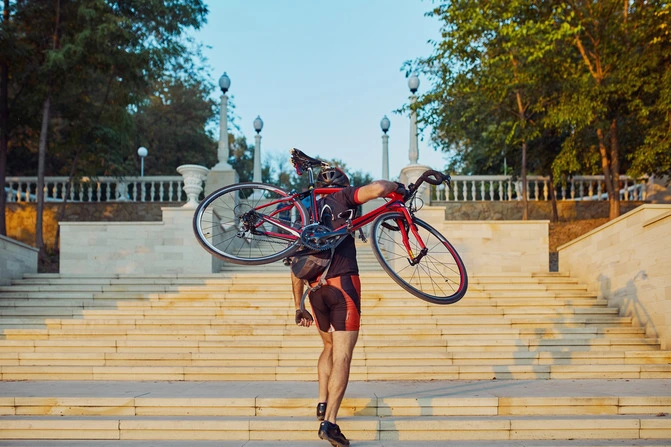
Triathlon combines three sports: swimming, cycling and running. In a full-distance Ironman, athletes swim approximately 3.8 kilometres, cycle 180 kilometres and finish with a 42.195-kilometre marathon. More than 226 kilometres of physical and mental effort.
Endurance training helps the cardiovascular system deliver oxygen and the muscles use it to sustain prolonged activity. Moving from one discipline to another also calls for adjustments in posture, coordination and muscular effort.
Nutrition, hydration, recovery and body-temperature regulation matter greatly. True endurance also means learning to listen to our bodies. The man who faced the prospect of not being able to walk 100 metres In 2016, Spanish director Marcel Barrena released 100 Metres, starring Dani Rovira and inspired by the real-life story of Ramón Arroyo.
Ramón was diagnosed with multiple sclerosis in 2004. Faced with uncertainty about his mobility, he decided to undertake an extraordinary challenge. On 6 October 2013, nine years after his diagnosis, he completed a full-distance Ironman triathlon. A man who had experienced serious difficulties walking covered more than 226 kilometres.
Yet his story did not end at the finish line. Ramón continued to live with multiple sclerosis. His sporting achievement did not mean a permanent recovery from illness; it meant discovering new possibilities within his own circumstances.
Science and Hope
Multiple sclerosis is a disease in which the immune system damages structures in the central nervous system. Its effects may include difficulties with movement, vision, balance and other neurological functions.
Research supports appropriately adapted physical activity for many people living with this condition. Exercise, however, is not a cure and cannot replace medical treatment. Individual assessment and activity suited to each person’s abilities and health are important.
Ramón’s story should inspire us, never become a demand imposed on others who live with the same illness. There is extraordinary courage, too, in someone struggling each morning simply to get out of bed.
When Medals are not Enough
Spanish physician and athlete Susana Rodríguez, who has a visual impairment, won Paralympic gold medals in paratriathlon at Tokyo and Paris. Her commitment to medicine, alongside her sporting career, reminds us that human greatness can take many forms. Two vocations, one life: striving to improve and striving to serve. Not every victory requires a podium, and not every hero needs a medal.
The Three Disciplines of Our Existence
We may never have the opportunity to swim four kilometres, cycle for hours or run a marathon. Yet we can all take part in a far more meaningful triathlon.
1. Forgiving
Forgiveness does not mean excusing harm or abandoning justice. It means exploring the possibility of continuing our lives without remaining prisoners of resentment.
2. Loving
Loving our children, our parents and our friends. Learning to express our feelings while there is still time, before an embrace we keep postponing becomes an impossible memory.
3. Fighting for Others
For those who lack opportunities, those who are ill, children who suffer, and people who have lost hope and need a helping hand to continue their journey.
Conclusion
In a sporting competition, each participant strives to reach the finish line. In life, perhaps our greatest victory is helping others reach theirs. It does not matter how many kilometres we cover, how many medals we win or how much applause we receive.
When we reach the final milestone of our lives, perhaps what will matter most is not how far we travelled ourselves, but how many people were able to move forward because we stood beside them. May we never lack the generosity to forgive, the heart to love or the courage to fight for others. That is the great triathlon of life.
Scientific, Sporting and Film References
- World Health Organization. Multiple sclerosis. https://www.who.int/news-room/fact-sheets/detail/multiple-sclerosis
- Kalb et al. (2020). Exercise and lifestyle physical activity recommendations for people with multiple sclerosis throughout the disease course. https://doi.org/10.1177/1352458520915629
- Effects of Training on Cardiorespiratory Fitness in Triathletes: A Systematic Review and Meta-Analysis (2021). https://pmc.ncbi.nlm.nih.gov/articles/PMC8703306/
- Ambrosini et al. (2022). Interlink Between Physiological and Biomechanical Changes in the Swim-to-Cycle Transition in Triathlon Events: A Narrative Review. https://doi.org/10.1186/s40798-022-00521-z
- Factors influencing pacing in triathlon (2014). https://pmc.ncbi.nlm.nih.gov/articles/PMC4172046/
- Fundación Caser. Ramón Arroyo: Rendirse no es una opción. https://www.fundacioncaser.org/actividades/historias-de-superacion/rendirse-no-es-una-opcion
- Spanish Ministry of Culture, ICAA film catalogue. 100 metros (2016), directed by Marcel Barrena. https://sede.mcu.gob.es/CatalogoICAA/en-us/Peliculas/Detalle?Pelicula=113515
- World Triathlon (2024). Susana Rodriguez steps into history and claims her second Paralympic gold. https://oceania.triathlon.org/news/susana-rodriguez-steps-into-history-and-claims-her-second-paralympic-gold