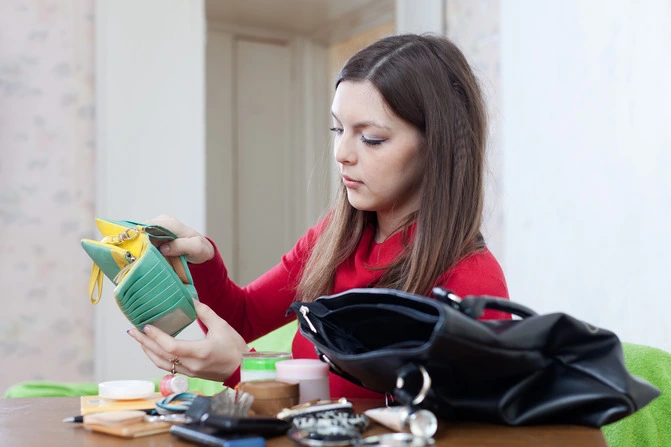
Humanity reached the Moon, sent robots to Mars and developed astonishing technologies. Yet we still walk into a room and forget what we were looking for. How can our brains be so brilliant and so absent-minded?
We look for the glasses resting on our heads, lose the television remote, talk on the phone while searching for it, and call our children by the names of all their siblings. Psychology, science and family therapy have much to say about these scenes that make us laugh and sometimes conceal lives full of responsibilities.
We're Geniuses... But We Can't Find Our Keys!
Human beings are truly extraordinary.
We built aeroplanes, discovered vaccines, developed computers and reached the Moon.
Yet every morning, somewhere on the planet, someone cries out in desperation:
"I can't find the car keys!"
An investigation worthy of the world's finest detectives begins.
Pockets, bedrooms and kitchens are searched. Family members are questioned, and even the dog is blamed.
Finally, the keys turn up.
They were in our own hand!
Humanity intends to conquer Mars, yet it has just been defeated by a keyring.
The Glasses: A Mysterious Disappearance
Another scene worthy of an international award.
Someone loses their glasses and mobilises the entire family.
"Someone must have moved them!"
Cushions are lifted, drawers are searched and the space beneath the bed is inspected.
Until someone asks:
"What about those on your head?"
Absolute silence.
The glasses were there the entire time.
The investigation concludes successfully, although nobody wishes to make a statement to the press.
Carlos, Juan, Matías... and Even the Dog!
A mother needs to call Matías.
"Carlos! Juan! Pedro! Matías!"
Finally, the boy appears.
"What is it, Mum?"
"I've been calling you for ages!"
"But you called all my brothers first!"
In some families, the operation includes the dog:
"Carlos, Juan, Matías, Firulais! Oh, you know who I'm calling!"
Amusingly, this phenomenon has a scientific explanation.
In 2016, researchers at Duke University published a study on the confusion of names among familiar individuals.
They found that we tend to substitute the names of family members with those of other relatives. They even recorded instances involving the family dog's name.
It does not mean that a mother loves her children any less or has forgotten who they are.
Our brains organise names through associations and sometimes retrieve the wrong one.
What Does Psychology Tell Us?
Harvard University psychologist Daniel Schacter has investigated everyday memory errors.
One of his explanations concerns attention.
When we leave our keys on a table while thinking about something else, we may not adequately register where we put them.
Later, we try to retrieve a memory that barely formed in the first place.
That is why it is important to distinguish between forgetting something and not having paid enough attention to it.
Stress can also play a role. A scientific review by Shields and colleagues found that acute stress can impair certain cognitive functions, such as working memory.
Are we losing our memory, or are our worries so overwhelming that we stop paying attention to small details?
There is no single answer that applies to every case.
The Mother with a Thousand Things on Her Mind
Many mothers start their day thinking about breakfast, school schedules, work, bills, medical appointments and their children's emotional needs.
While cooking, they remember a meeting. While working, they think about who will collect the children.
Sociologist Allison Daminger investigated this phenomenon, known as cognitive household labour.
It involves not only performing tasks but also anticipating them, organising them and making sure they have been completed.
In her study, women took on a greater share of this invisible planning.
This does not mean that every household is the same. Many fathers also face enormous responsibilities.
Nevertheless, it invites us to ask a question:
How many things must one person remember so that the rest of the family can comfortably forget them?
What Does Family Therapy Suggest?
Family therapy does not regard losing one's keys, in itself, as a psychological problem.
It also considers how the family is organised, how its members communicate and how they share responsibilities.
One important recommendation is to share not only the tasks themselves but also the responsibility for remembering them.
If one person organises every medical appointment, school commitment and household need, that person may become overwhelmed.
Communication matters, too.
Instead of saying:
"Mum, you've lost the remote again!"
We could ask:
"Shall I help you look for it? Is there anything else we can do?"
It may seem like a small change, but it expresses an enormous difference: moving from criticism to collaboration.
The Television Remote and The Mystery of Doorways
There is an object that mysteriously disappears in millions of homes: the television remote.
"Who's got the remote?"
"Not me!"
"Your brother had it!"
After lifting every cushion, someone discovers that it was underneath the very person who was looking for it.
And there is yet another mystery.
We walk into the kitchen and stop.
"Why did I come in here?"
In 2011, researchers at the University of Notre Dame observed experimentally that walking through a doorway could make certain recent memories harder to retrieve.
One explanation is that our brains update information when the context changes.
This does not mean that every doorway makes us forget, but it helps explain an experience familiar to millions of people.
The Phone We were Looking For
Technology has not saved us, either.
"I've lost my mobile phone!"
"And what are you calling me from?"
A pause.
We look at our hand.
We're talking on the very phone we were searching for!
We must admit it: our species is extraordinary, even if it sometimes needs help finding what is right in front of it.
Memory Can Fail; Love is Not Measured by it
Occasionally forgetting where we left an object is generally normal. If memory problems persist, worsen or interfere with daily life, it is advisable to consult a healthcare professional.
But we must also learn to respect the tiredness and worries of those who share our lives.
A mother may confuse her children's names while perfectly remembering their birthdays, their joys and their sorrows.
A father may forget his car keys and yet treasure for the rest of his life the memory of his daughter's first embrace.
And the next time we hear:
"Carlos, Juan, Matías! You, come here!"
Perhaps the best answer will be:
"Here I am, Mum! Can I help you with something?"
Because we reached the Moon, explored Mars and dream of conquering the stars.
Yet we still have four mysteries to solve:
Where are the house or car keys?
Has anyone seen our glasses?
Where did the television remote disappear to?
And please... does anybody remember why we went into the kitchen?
While we look for the answers, let us keep laughing together.
Because in a family, it matters far less who forgot the keys, who lost the glasses or who mixed up the names.
What truly matters is that, amid all the things we forget every day, we never forget to care for those we love.
References
-
Schacter, D. L. (1999). The seven sins of memory: Insights from psychology and cognitive neuroscience. American Psychologist. https://doi.org/10.1037/0003-066X.54.3.182
-
Deffler, S. A., Fox, C., Ogle, C. M., & Rubin, D. C. (2016, online publication). All my children: The roles of semantic category and phonetic similarity in the misnaming of familiar individuals. Memory & Cognition. https://doi.org/10.3758/s13421-016-0613-z
-
Daminger, A. (2019). The cognitive dimension of household labor. American Sociological Review. https://doi.org/10.1177/0003122419859007
-
Shields, G. S., Sazma, M. A., & Yonelinas, A. P. (2016). The effects of acute stress on core executive functions. Neuroscience & Biobehavioral Reviews. https://doi.org/10.1016/j.neubiorev.2016.06.038
-
Radvansky, G. A., Krawietz, S. A., & Tamplin, A. K. (2011). Walking through doorways causes forgetting: Further explorations. Quarterly Journal of Experimental Psychology. https://doi.org/10.1080/17470218.2011.571267
-
American Psychological Association. Making Working Families Work. https://www.apa.org/monitor/dec05/work.aspx

 Mehvish Batool

 Meenakshi Jagdale