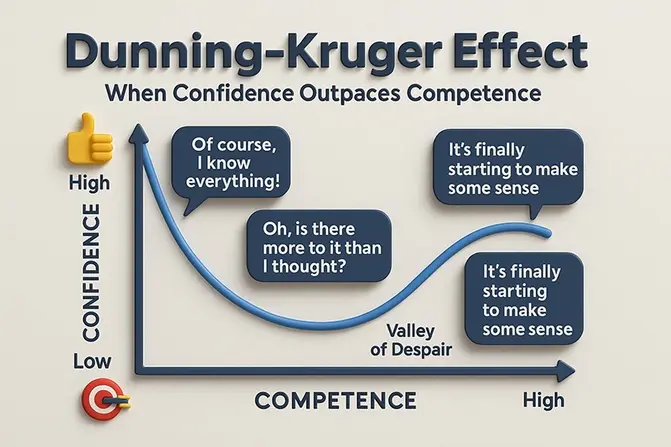
In everyday life, we encounter people who speak with remarkable certainty about subjects they understand only superficially. They may offer definitive opinions on medical treatment, complex legal questions, financial investments or the stock market, often without the necessary training or evidence. At the other end of the spectrum are knowledgeable and experienced individuals who remain aware of how much they still have to learn. This contrast is often discussed through the Dunning–Kruger effect, a concept in cognitive psychology concerning the relationship between competence, self-assessment and metacognitive awareness.
The Dunning–Kruger effect takes its name from psychologists David Dunning and Justin Kruger, whose influential 1999 study examined how people assess their own abilities. Their research suggested that, in certain tasks, individuals with weaker performance may overestimate their competence. One reason is that the skills required to perform a task well can overlap with the skills needed to evaluate one’s own performance. When those skills are underdeveloped, a person may struggle not only to perform effectively but also to recognise the shortcomings in their performance.
This does not mean that every inexperienced person is overconfident, or that every expert is necessarily modest. Nor is the effect a clinical diagnosis or a measure of a person’s overall intelligence. It describes a pattern of inaccurate self-evaluation observed in particular contexts. Confidence, competence and self-awareness are related, but they are not interchangeable.
How Can It Appear in Everyday Life?
Social media provides a familiar setting in which this pattern may be observed. People sometimes make categorical claims about medicine, law, economics or investments after encountering only a small amount of information. Their certainty may make their statements sound authoritative, even when the claims have not been checked against reliable evidence. Readers who have less knowledge of the subject may find such confidence persuasive. This is one reason why checking sources and consulting qualified professionals are essential, especially when decisions involve health, money or legal rights.
A novice driver offers another useful illustration. After learning the basic controls of a vehicle, a new driver may initially feel highly capable. With experience, however, the driver begins to recognise the complexity of road conditions, traffic behaviour, weather, risk assessment and emergency responses. Greater experience can bring a more realistic understanding of personal limitations. This is an illustration of how learning may change self-assessment; it is not, by itself, proof of the Dunning–Kruger effect.
A similar situation can arise in the workplace. A recently appointed employee may assume that academic knowledge alone is sufficient to judge established procedures or experienced colleagues. Without understanding the organisation’s history, operational constraints and practical challenges, the employee may dismiss methods that have developed through years of experience. Constructive questioning is valuable, but it becomes more effective when combined with listening, evidence and an appreciation of context.
The Possible Benefits and The Risks of Overconfidence
An initial sense of confidence can sometimes help people begin unfamiliar tasks. If individuals focused only on every possible obstacle, they might hesitate to take the first step. A degree of optimism can support initiative, experimentation and willingness to learn. However, this should not be confused with the Dunning–Kruger effect itself. Healthy confidence is compatible with curiosity, preparation and openness to correction; overconfidence becomes problematic when it is disconnected from evidence and actual ability.
The risks emerge when a person assumes that there is nothing more to learn. Such a belief can discourage further education, prevent the acceptance of feedback and slow professional or personal development. It may also lead to poor decisions. In financial matters, unverified assumptions can result in monetary loss. In relationships, refusing to listen can deepen misunderstandings and conflict. At work, dismissing experienced advice can damage performance and teamwork.
The consequences may be especially serious when a person holds a position of responsibility. A decision-maker who overestimates their knowledge and ignores relevant expertise may place employees, clients, patients, family members or members of the public at risk. The central concern is not confidence itself, but confidence that is insufficiently tested and unwilling to be corrected.
Illustrative Cases: Learning From History
One frequently discussed example associated with the original research is McArthur Wheeler, who attempted to rob banks in Pittsburgh in 1995. According to the account cited by Kruger and Dunning, Wheeler believed that applying lemon juice to his face would make him invisible to security cameras, apparently drawing an incorrect analogy with invisible ink. He was identified and arrested. The episode illustrates how a mistaken understanding, combined with misplaced certainty, can produce a striking failure of judgement. It should be treated as an illustrative anecdote, rather than as a psychological assessment of the individual.
Napoleon Bonaparte’s 1812 invasion of Russia is another historical episode that can be discussed in terms of strategic overconfidence. After a series of military successes, Napoleon undertook a campaign that exposed his forces to enormous logistical, geographic and climatic challenges, as well as Russian resistance. The Grande Armée suffered catastrophic losses during the campaign and retreat. Historians examine many political, military and logistical factors behind the disaster; it would be inaccurate to diagnose Napoleon retrospectively with the Dunning–Kruger effect. Nevertheless, the campaign reminds us that previous success does not guarantee sound judgement in a new and unfamiliar situation.
Engineering disasters also demonstrate the danger of inadequate assumptions and insufficiently tested designs. The 1940 collapse of the Tacoma Narrows Bridge in the United States was caused by complex aerodynamic and aeroelastic effects. It should not be presented as proof of engineers’ overconfidence or as a documented Dunning–Kruger case. Its more defensible lesson is that technical decisions require rigorous analysis, testing, peer review and a willingness to revise assumptions when evidence demands it.
In contemporary business, the cases of Sam Bankman-Fried and Elizabeth Holmes have prompted widespread discussion about leadership, claims, governance and accountability. However, it would be inappropriate to label either individual as an established example of the Dunning–Kruger effect without specific evidence. Their cases can instead remind us more broadly that persuasive confidence and ambitious claims must never replace independent verification, transparency, scientific standards or regulatory oversight.
How Can We Avoid This Cognitive Trap?
The first step is to develop the habit of asking: “What evidence supports what I am saying?” Before making a strong claim or an important decision, we should distinguish facts from assumptions, personal impressions and hearsay. Reliable sources, relevant data and professional advice are particularly important in areas where mistakes can cause serious harm.
The second step is to welcome constructive feedback. When an experienced person points out an error, our first response need not be defensiveness or anger. We can treat the feedback as an opportunity to examine our reasoning, ask questions and improve. Seeking a second opinion, inviting peer review and learning from people with different expertise can help us identify blind spots.
The third step is to practise intellectual humility. Humility does not mean undervaluing our abilities; it means recognising that our knowledge has limits and that those limits may change from one subject to another. We should respect others, avoid belittling people to establish our own superiority, and remain willing to update our views when better evidence becomes available.
Regular self-reflection is equally important. We can review past decisions, identify what went wrong, consider whose advice we ignored and ask what we would do differently next time. In families, workplaces and institutions, a culture in which people can raise concerns without fear is essential. Leaders should encourage informed disagreement rather than surround themselves only with people who agree with them.
Conclusion: True Wisdom Begins With Self-Awareness
The Dunning–Kruger effect offers an important reminder: the way we judge our own knowledge may not always reflect our actual competence. Success in one area does not automatically make a person an expert in every other area. Equally, a lack of confidence does not necessarily indicate a lack of ability. Accurate self-assessment requires practice, feedback, evidence and experience.
Whether we are professionals, parents, educators, public representatives, managers or students, we should remain alert to the possibility of our own blind spots. Before criticising others or making decisions that affect their lives, we should pause, verify our understanding and seek informed guidance where necessary.
The world’s knowledge is vast, and each of us holds only a small part of it. Recognising this is not a weakness; it is a sign of maturity. Real wisdom is not demonstrated by speaking with absolute certainty about everything. It is demonstrated by knowing when to speak, when to listen, when to question and, most importantly, when to learn.
References
Kruger, J., & Dunning, D. (1999). Unskilled and unaware of it: How difficulties in recognizing one's own incompetence lead to inflated self-assessments. Journal of Personality and Social Psychology, 77(6), 1121–1134. https://doi.org/10.1037/0022-3514.77.6.1121
Dunning, D. (2011). The Dunning–Kruger effect: On being ignorant of one's own ignorance. In J. M. Olson & M. P. Zanna (Eds.), Advances in Experimental Social Psychology (Vol. 44, pp. 247–296). Academic Press.


 Mehvish Batool
 Waqar Ahmad