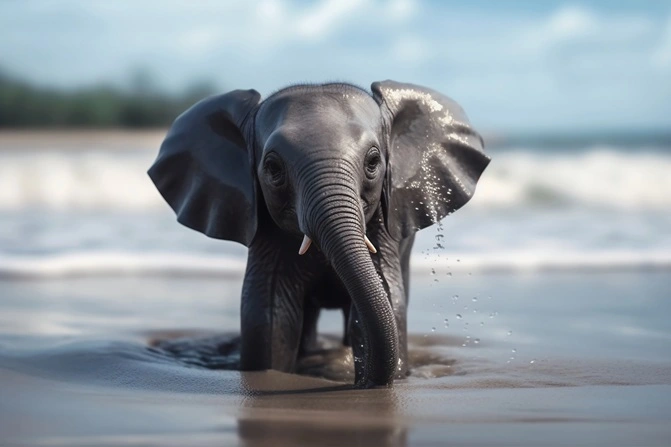
Across the vast African savannah, as the wind brushes the earth and the sun begins to disappear over the horizon, a group of elephants stops before some bones. They examine them, smell them and touch them with their trunks. They remain there for a while before continuing on their journey.
What happens in their minds? Do they experience absence? Do they understand death? Is there something in the animal world akin to our nostalgia? Science is beginning to offer answers that could transform our understanding of these extraordinary inhabitants of our planet.
The Memory of Giants
For generations we have heard that elephants never forget. Although this saying should not be taken literally, their spatial and social memory abilities are remarkable. In 2001, researcher Karen McComb and her colleagues demonstrated that older matriarchs possessed social knowledge that was particularly valuable to their families.
The grandmothers of the savannah are true guardians of collective experience. Their knowledge contributes to the survival of new generations.
Thirteen Years Without Forgetting Those Who Cared for Them
On 7 October 2024, a study from Kiel University in Germany, published online in Zoo Biology, offered surprising evidence. Bibi and Panya, two African elephants, had been moved from Berlin Zoo to the Serengeti Park in Hodenhagen.
Researchers presented them with photographs, voice recordings and clothing associated with their former keepers and unfamiliar people. After up to thirteen years without contact, both elephants showed greater interest in the scent of their former keepers.
Led by Christine Böhmer, the study provides evidence that elephants can retain memories of humans over long periods. Although only two animals participated, the discovery invites us to reflect. If an elephant can remember those who cared for it after thirteen years, why do we so easily forget those who once extended a helping hand to us?
When They Return to Encounter Their Dead
In 2006, a study published in Biology Letters demonstrated that African elephants show particular interest in the skulls and ivory of their own species, even when these do not belong to members of their family. In 2020, Shifra Goldenberg and George Wittemyer described elephant responses to dead elephants in Kenya’s Samburu National Reserve.
In August 2026, a study led by Matthew Bowers reported thirty-four distinct visits to the site where an elephant had died in southern Kenya. The animals explored its remains. We cannot establish that they experience grief exactly as we do, but these behaviours deserve our attention and respect.
Do Elephants Bury Their Dead?
In 2024, researchers Parveen Kaswan and Akashdeep Roy documented five cases of Asian elephant calves found covered with earth in tea plantations in northern Bengal, India. The authors suggested that other elephants may have carried and covered the bodies.
Whether these were intentional burials remains a matter for further investigation, but the observations raise new questions about their relationship with death.
The Language of Touch
In 2014, Joshua Plotnik and Frans de Waal documented how Asian elephants in Thailand approached other individuals showing signs of distress, making physical contact and vocalising. These behaviours are consistent with reassurance and consolation.
A trunk gently touching another elephant can be a way of offering companionship. In 2024, Michael Pardo and his colleagues found evidence of individually directed vocalisations comparable in some respects to our names.
That same year, Vesta Eleuteri and her team studied how elephants combine sounds and gestures when greeting one another.
When a Living Library Disappears
In 2025, a scientific review of ninety-five studies examined the consequences of disruption to elephant societies and the loss of their members. When poaching takes the life of an experienced elephant, part of the knowledge that might help others survive may disappear as well. Protecting elephants means protecting their families, their territories and their heritage of experience.
Let us Learn to Have an Elephant’s Memory
Human beings have built cities, ventured into space and developed extraordinary technologies. Yet we still have much to learn about gratitude, solidarity and companionship. Let us learn from elephants never to forget those who helped us, those who extended a hand when we needed it most, and those who stood beside us through difficult times.
But let us not forget those who need us today either. Especially the children of the world. Those who suffer hunger, who endure war, who grow up in loneliness or who are waiting for an opportunity to move forward.
May our memory serve not only to remember our past but also to understand their lives and help build a more dignified future for them. Perhaps elephants will never need to learn to behave like human beings.
Perhaps we are the ones who need to learn to behave a little more like elephants. May we never lack the memory to be grateful, the heart to accompany others, or the will to help. May we all have an elephant’s memory.
Scientific References
- McComb et al. (2001). Matriarchs as repositories of social knowledge in African elephants. Science. https://doi.org/10.1126/science.1057895
- Kränzlin et al. (2024, online publication). Do African savanna elephants show interspecific social long-term memory for their zoo keepers? Zoo Biology. https://doi.org/10.1002/zoo.21871
- McComb, Baker & Moss (2006). African elephants show high levels of interest in the skulls and ivory of their own species. Biology Letters. https://doi.org/10.1098/rsbl.2005.0400
- Goldenberg & Wittemyer (2020). Elephant behavior toward the dead: A review and insights from field observations. Primates. https://doi.org/10.1007/s10329-019-00766-5
- Bowers et al. (2026). African savannah elephant interactions at elephant bones: Observations from southern Kenya. African Journal of Ecology. https://doi.org/10.1111/aje.70211
- Kaswan & Roy (2024). Unearthing calf burials among Asian elephants in northern Bengal, India. Journal of Threatened Taxa. https://doi.org/10.11609/jott.8826.16.2.24615-24629
- Plotnik & de Waal (2014). Asian elephants reassure others in distress. PeerJ. https://doi.org/10.7717/peerj.278
- Pardo et al. (2024). African elephants address one another with individually specific name-like calls. Nature Ecology & Evolution. https://doi.org/10.1038/s41559-024-02420-w
- Eleuteri et al. (2024). Multimodal communication and audience directedness in the greeting behaviour of semi-captive African savannah elephants. Communications Biology. https://doi.org/10.1038/s42003-024-06133-5
- Bates et al. (2025). Knowledge transmission, culture and the consequences of social disruption in wild elephants. Philosophical Transactions of the Royal Society B. https://doi.org/10.1098/rstb.2024.0132