Some encounters begin without words: a girl reaches out to a dog, a patient works on balance while riding a horse, and an older person smiles while stroking a rabbit. None of these animals offers a miraculous cure. Yet their presence, carefully integrated into a treatment plan, may open pathways to trust, movement and communication.
Animal-assisted interventions are structured activities that involve appropriately selected animals to pursue health, educational or wellbeing objectives. When an intervention is clinical therapy, qualified professionals must set goals and follow outcomes. A recreational visit, however touching, is not automatically medical treatment.
Autism: Communication without Demanding Words
For some autistic children and adults, interacting with an animal may support sensory experiences, shared attention and social activities. But every autistic person is different: not everyone welcomes the sounds, movement or physical contact of an animal.
A 2024 review in Frontiers in Veterinary Science examined 45 studies involving 1,212 participants. It found encouraging signals in certain social and behavioural outcomes, while highlighting important differences between studies. Animal-assisted interventions do not eliminate autism and must not be framed as a correction of neurodiversity.
In an Australian school-based study, 64 autistic children participated in activities involving guinea pigs over eight weeks. Teachers and families reported improvements in some measures of social functioning. The results justify further research, not a promise of identical outcomes in every classroom.
Horses: Science in Motion
The rhythmic movement of a walking horse can be used by physiotherapists and occupational therapists to work on posture, balance and coordination. Hippotherapy specifically uses the horse’s movement as a clinical tool; other equine activities may pursue psychological or educational aims and should not be confused with it.
In 2026, researchers reported a randomized study involving 72 autistic children aged six to eleven. Over ten weeks, they compared conventional occupational therapy with sessions incorporating horses. The horse-assisted group showed greater reductions in salivary cortisol after therapy sessions than the clinic-based group. However, the study did not establish lasting changes in cortisol levels throughout the programme or demonstrate that horse-assisted therapy treats autism.
When Bombs Silence Childhood
In Kharkiv, Ukraine, metro stations converted into shelters also hosted sessions involving therapy dogs. UNICEF documented Julie, a golden retriever who joined activities with children coping with the fear of attacks. In such circumstances, playing, approaching an animal and recovering moments of calm can matter greatly.
That experience does not establish that a dog can cure bombing-related trauma on its own. It does show how these interventions can form part of broader humanitarian support, alongside psychological care and family assistance.
Among US service members and veterans living with post-traumatic stress disorder (PTSD), a study in JAMA Network Open analysed 156 participants. Those who received psychiatric service dogs in addition to usual care had lower PTSD, anxiety and depression symptoms after three months. Because the trial was not randomised, its findings require caution.
Rabbits, Cats and Other Companions
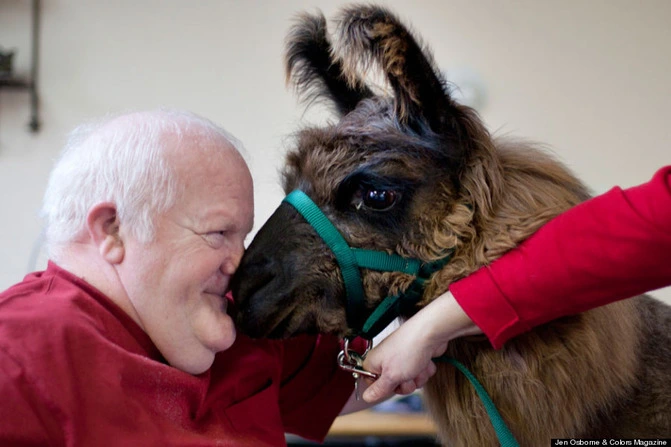
Dogs and horses are not the only participants. Pet Partners assesses and registers human–animal teams involving cats, rabbits, guinea pigs, domestic rats, birds, miniature pigs, llamas and alpacas, as well as equines.
These animals may take part in supervised visits to schools, residential facilities and care settings when their health, temperament and handling are suitable. Registration does not, however, scientifically certify the clinical effectiveness of every species. Evidence for some remains limited.
For older adults in residential care, supervised visits may create opportunities for conversation, memories and social connection. For someone who spends much of the day in silence, the sound of a dog approaching may become a welcome event. Yet this human value should not be mistaken for universal clinical results: programmes need consent, realistic aims and assessment, especially where mobility or immune vulnerability is a concern.
A rabbit must never be forced to endure unwanted handling; nor should a cat, horse or dog. International guidance stresses protection for both participants: people and animals. Hygiene, allergies, bite prevention, rest breaks and signs of distress all require attention.
Wellbeing Has Four Paws, Too
Why might animals help? Researchers are studying attention, motivation, social contact and physiological responses such as cortisol and heart rate. Findings vary by diagnosis, species, setting and programme quality. Enthusiasm and scientific rigour must therefore go together.
Outside hospitals, animals also enrich everyday life. They invite us to care, observe, play and take responsibility. Sometimes they accompany difficult silences; at other times they share our ordinary joy.
The true secret language of healing is not a supernatural power. It is the possibility of building respectful relationships in which science sets boundaries and tenderness has a place.
Because animals do not need words to accompany us; we are the ones who must learn to listen to them.
References
- Xiao et al. (2024), Frontiers in Veterinary Science: https://www.frontiersin.org/journals/veterinary-science/articles/10.3389/fvets.2024.1403527/full
- Colorado State University (2026), Journal of Autism and Developmental Disorders: https://link.springer.com/article/10.1007/s10803-026-07540-9
- UNICEF Ukraine — Dogs help children in Ukraine to cope with stress: https://www.unicef.org/ukraine/en/stories/dogs-help-children-to-cope-with-stress
- Leighton et al. (2024), JAMA Network Open: https://jamanetwork.com/journals/jamanetworkopen/fullarticle/2819452
- Pet Partners — Therapy animal team registration: https://petpartners.org/
- O'Haire, M. E., McKenzie, S. J., McCune, S., & Slaughter, V. (2013). Effects of classroom animal-assisted activities on social functioning in children with autism spectrum disorder. The Journal of Alternative and Complementary Medicine, 19(2), 162–168. https://doi.org/10.1089/acm.2013.0165

 Amna Zaheer

 Amna Irshad