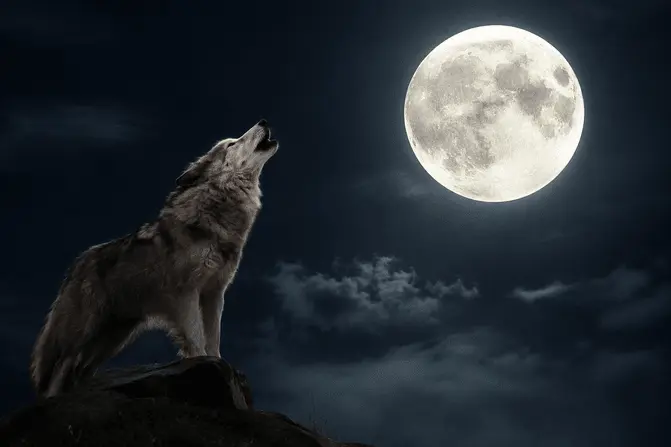
An unusually busy night ends. Someone looks out of a window and sees a full moon. By morning, the two events may have become a single story. Imagine the same night under a thin crescent. Would anyone have looked up for an explanation?
For centuries, the full moon has been linked in folklore to restless nights and strange behaviour. The Moon does have a measurable influence on the natural world. Its gravity, together with the Sun’s, helps drive ocean tides, and the average tidal range is larger around both the full and new moon. To test a claim about human behaviour, we need records of what people did or experienced and a way to compare nights across the lunar cycle. [1]
Why Some Nights Stay with Us
Psychologist Raymond Nickerson described confirmation bias as the tendency to seek out and interpret evidence in ways that favour what we already believe. A person who expects trouble on a full-moon night has a reason to notice a coincidence and a ready-made story to tell about it. A quiet night under a full moon may pass without comment. An equally chaotic night at another phase may be remembered for something else entirely. [2]
Over time, those selective memories can make the pattern feel stronger than it is. Think of a hospital shift where several patients arrive in quick succession. If one colleague says, ‘It must be the full moon’, the remark makes the phase of the Moon part of that night’s story. To find out whether there is a real pattern, we would need to count busy and quiet shifts across the lunar cycle, including the nights nobody felt like telling a story about.
What Psychiatric Hospital Records Show
In 2019, Rahul Gupta and colleagues analysed 17,966 cases of inpatient psychiatric care at clinics in the Swiss canton of Grisons. They compared admissions, discharges and length of stay across lunar phases and nearby days. They found no association for any of those three measures. The finding concerns hospital activity in those clinics. Questions about what people feel at home, or about emergency visits that do not lead to admission, would require other data. [3]
What the Sleep Studies Found
In 2013, Christian Cajochen and colleagues went back to sleep recordings from a controlled laboratory study and compared them by lunar phase. Around the full moon, participants took about five minutes longer to fall asleep and slept about 20 minutes less. One measure of brain activity associated with deep sleep was about 30 per cent lower. In 2014, Maren Cordi and colleagues reanalysed recordings from three larger samples and could not reproduce those findings. [4][5]
In 2021, Leandro Casiraghi and colleagues used wrist monitors to study sleep in three Toba-Qom communities in Argentina with different levels of access to electricity. In those communities, sleep started latest and was shortest, on average, three to five nights before the full moon. The researchers saw a similar pattern in data from university students in Seattle. They suggested that evening moonlight might help explain the timing. Because the study observed people going about their lives, the cause remains open. [6]
The open question is whether those average patterns recur reliably across different groups and settings.
The Next Morning
On 24 November 2026, the Moon will be full. Someone who spends that night counting the hours may remember the Moon at the window. A week later, after another restless night, the same person might remember only the numbers on the clock. What would the story sound like if we remembered both nights? [7]
References
1. NOAA. What are spring and neap tides?
4. Cajochen C et al. Evidence that the lunar cycle influences human sleep. Current Biology, 2013.
5. Cordi M et al. Lunar cycle effects on sleep and the file drawer problem. Current Biology, 2014.
7. US Naval Observatory. Dates of Primary Phases of the Moon, 2026.
 Dr. Masica D. Jordan Alston
 Mehvish Batool