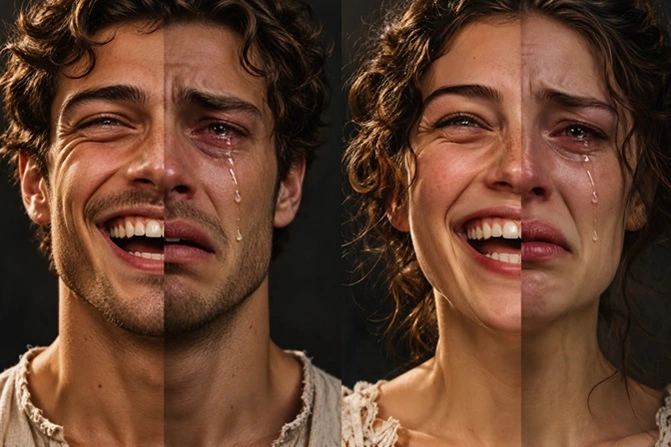
Picture a family gathered around a table. A child bursts into laughter, only to hear an adult interrupt: ‘Don’t laugh so much, or you’ll end up crying.’ Later, when something makes the same child sad, comes another command: ‘Don’t cry.’ Almost without noticing, we teach children to distrust joy and conceal sorrow.
For generations, these sayings have been repeated as if they were truths. But where did we get the idea that laughter attracts misfortune, or that tears are a sign of weakness?
Perhaps the adults who said them meant to protect us from pain, ridicule or disappointment. Yet protection should not mean silence. A culture afraid of tears may eventually become suspicious of happiness, too.
Science does not support these superstitions. Instead, it offers a more useful question: what happens when our bodies express what we feel?
Laughter Does Not Predict Tears
Laughter does not determine what will happen tomorrow. There is no known mechanism through which a good laugh summons misfortune. There is, however, research exploring how laughter relates to physiological responses to stress.
In 2023, Caroline Kaercher Kramer and Cristiane Bauermann Leitão reviewed eight studies involving 315 participants. Their meta-analysis, published in PLOS ONE, found that interventions based on spontaneous laughter were associated with an average 31.9% reduction in cortisol levels compared with control conditions.
The finding is interesting, but laughter is not a prescription drug: the evidence base was limited, and clinical implications require further investigation.
The lesson is simpler. A moment of happiness deserves room to exist, not a warning.
Joy Also Builds Connections
In Finland, Sandra Manninen and colleagues studied shared laughter using brain imaging in 2017. They found indications of endogenous opioid release, a system associated with pleasure and social bonding.
Only 12 men took part in the neuroimaging component, so the findings should not be generalised too broadly. Still, the research offers a possible explanation for something we already recognise in everyday life.
We may forget the joke told around a family table, but remember the person we laughed with. Sometimes laughter is a way of meeting one another.
Tears are Not a Failure
The other prohibition is quieter: ‘Don’t cry.’ Sometimes it comes with an even harsher message: ‘Men don’t cry’ — as though dignity required us to hide pain.
In 2021, Janis H. Zickfeld and an international team studied 7,007 people across 41 countries. Their work in the Journal of Experimental Social Psychology found that seeing tears on a face increased observers’ willingness to offer support.
This does not mean every tear receives comfort. It suggests, however, that crying may act as a social signal of vulnerability.
At times, courage means not holding everything in. And kindness means asking ‘Would you like me to stay?’ instead of demanding ‘Be strong.’
Crying is Not a Universal Cure
We should dismantle another myth: science does not say crying always brings relief.
In 2011, Lauren Bylsma and colleagues analysed 1,004 crying episodes reported by 97 women. Only about one third were followed by an improvement in mood.
Context, companionship and personal experience matter. Some tears bring relief; others do not. The goal is not to make everyone cry, but to allow people to feel without shame or pressure.
When Emotions Overlap
We can also cry when we reunite with someone we love, or when wonderful news arrives.
In 2015, psychologist Oriana Aragón investigated these seemingly contradictory displays, known as dimorphous expressions. Her findings offered evidence that such expressions might help regulate especially intense positive emotions.
Cinema has long portrayed this complexity. Charlie Chaplin’s City Lights carries us from laughter to tenderness. Roberto Benigni’s Life Is Beautiful brings smiles and sorrow into the same story.
These films are not scientific studies. They are mirrors in which we recognise our humanity.
Changing the Words
We cannot prevent every sadness or guarantee every joy. But we can change the phrases that once taught us to hide them.
Instead of ‘Don’t cry,’ we might say ‘I’m here.’ Instead of ‘You’ll cry if you laugh that much,’ we can simply join the laughter.
Emotional education does not mean banning feelings. It means understanding them, offering support, and learning to express them without hurting ourselves or others.
For years, many of us were told to suppress tears and mistrust laughter. Perhaps it is time to teach something different: we do not need permission to feel.
Research Sources
Kramer & Leitão (2023), PLOS ONE: https://doi.org/10.1371/journal.pone.0286260
Manninen et al. (2017), Journal of Neuroscience: https://doi.org/10.1523/JNEUROSCI.0688-16.2017
Zickfeld et al. (2021), Journal of Experimental Social Psychology: https://www.sciencedirect.com/science/article/pii/S0022103121000378
Bylsma et al. (2011), Journal of Research in Personality: https://doi.org/10.1016/j.jrp.2011.04.007
Aragón et al. (2015), Psychological Science: https://doi.org/10.1177/0956797614561044


 Amna Irshad
 Kehinde Triumph

 Seerat Shah