
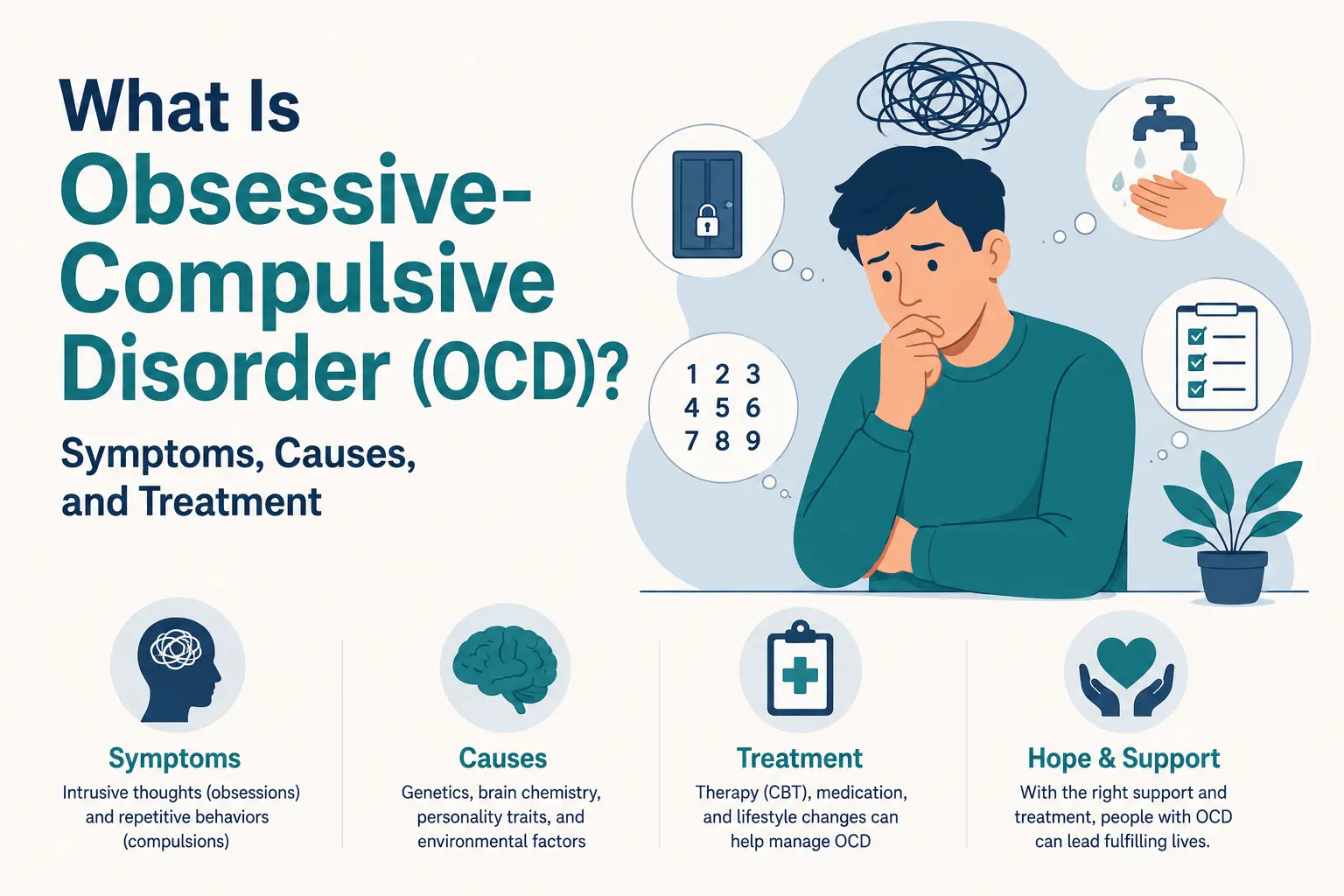
It is normal to check a locked door twice, worry about germs, or wonder if you made a mistake. Most people have thoughts and habits like these from time to time. They usually pass without causing serious problems.
For a person with Obsessive-Compulsive Disorder (OCD), these thoughts and behaviors can be much harder to control. Unwanted thoughts may return again and again. A person may then feel a strong need to check, clean, count, repeat something, or perform another action to feel safe or calm.
OCD is a mental health condition. It is not simply a love of cleaning or being organized. Symptoms can take up a lot of time and may affect school, work, relationships, sleep, and everyday activities.
This guide explains what OCD is, what obsessions and compulsions mean, common symptoms, possible causes, treatment options, and when professional support may help.
Medical note: This article is for general education. It does not replace advice, diagnosis, or treatment from a qualified healthcare or mental health professional.
What Is Obsessive-Compulsive Disorder?
Obsessive-compulsive disorder is a condition in which a person has unwanted and repeated thoughts, urges, or mental images called obsessions. They may also perform repeated behaviors or mental acts called compulsions.
Some people experience mainly obsessions. Others notice compulsions more clearly. Many experience both.
A simple example can make this easier to understand.
Imagine that someone has a strong fear that they left the front door unlocked. They check the door and see that it is locked. A few minutes later, doubt returns.
"What if I did not check properly?"
They go back and check again. The second check may bring relief, but only for a short time. Soon, the doubt returns.
This is one way the OCD cycle can develop.
OCD is part of a wider group of psychiatric disorders, but symptoms and experiences can differ greatly from one person to another.
What Are Obsessions?
Obsessions are thoughts, urges, fears, doubts, or mental images that keep returning even when a person does not want them.
They can feel upsetting, frightening, confusing, or embarrassing.
Common obsession themes may include:
- Fear of germs or contamination
- Fear of causing harm by mistake
- Worry about forgetting something important
- Fear of losing control
- A strong need for things to feel exact or "just right"
- Unwanted thoughts about religion, sex, violence, or other sensitive subjects
- Repeated doubts about relationships or important decisions
Having an unwanted thought does not mean a person agrees with it or wants to act on it.
This point matters because intrusive thoughts can cause a lot of shame. A person may think, "Why would I think something like that?"
In OCD, the fact that the thought feels unwanted and disturbing is often part of the problem.
What Are Compulsions?
Compulsions are repeated behaviors or mental actions that a person feels driven to perform.
The goal is often to reduce fear, doubt, or discomfort caused by an obsession. Sometimes the person believes the action may prevent something bad from happening.
Common compulsions can include:
- Washing hands again and again
- Checking doors, appliances, or belongings
- Counting in a certain pattern
- Repeating words or phrases
- Arranging objects in an exact way
- Asking another person for reassurance
- Repeating a task until it feels right
- Mentally reviewing an event again and again
A compulsion may make someone feel calmer for a short time. However, that relief can teach the brain to rely on the compulsion again when the fear returns.
How Does the OCD Cycle Work?
OCD often follows a repeating pattern.
- A Thought or Trigger Appears
A person sees, remembers, feels, or thinks something that creates doubt or fear.
For example:
"What if my hands are contaminated?"
- Distress Increases
The person may feel anxiety, fear, guilt, disgust, or a strong sense that something is wrong.
- A Compulsion Follows
They perform an action to reduce the uncomfortable feeling.
They may wash their hands, check something, ask for reassurance, or complete a mental ritual.
- Short-Term Relief Appears
The person feels better for a while.
- The Fear Returns
Because the compulsion brought relief, the brain may learn to use the same response again.
The pattern can then repeat:
Obsession or trigger → distress → compulsion → short-term relief → obsession returns
This helps explain why telling someone to "just stop" is rarely useful.
What Are the Common Signs and Symptoms of OCD?
OCD does not look exactly the same in every person.
Possible signs include:
- Thoughts that keep returning even when they are unwanted
- Repeated checking, washing, counting, or arranging
- Strong fear of making a mistake
- Needing reassurance again and again
- Avoiding people, objects, places, or situations because of fear
- Repeating tasks until they feel complete
- Spending a large amount of time on rituals
- Feeling distressed when unable to perform a ritual
- Difficulty focusing because of unwanted thoughts
The important issue is not simply whether a person has a habit.
Many people double-check things or enjoy routines.
OCD becomes more concerning when thoughts or behaviors are hard to control, cause clear distress, take up significant time, or interfere with normal life.
What Does OCD Feel Like?
Lists of symptoms do not always explain what living with OCD feels like.
For some people, it feels like never being completely sure.
They may know that a door is locked but still feel an urge to check again.
For others, it feels like being unable to trust their own thoughts or memory.
They may keep asking:
"Did I really do it?"
"What if I am wrong?"
"What if something happens because of me?"
Some people experience guilt or shame because of intrusive thoughts. Others feel exhausted because rituals take so much time.
OCD may also cause frustration because the person can understand that a fear seems excessive while still feeling unable to ignore it.
Common OCD Themes
People often use terms such as "contamination OCD" or "checking OCD." These are useful ways to describe common OCD themes, but they are not separate official disorders.
A person may also experience more than one theme at the same time.
Contamination Fears
A person may worry strongly about:
- Germs
- Dirt
- Illness
- Chemicals
- Bodily fluids
- Touching certain objects
They may wash, clean, avoid touching things, or ask others whether something is safe.
Checking
A person may repeatedly check:
- Door locks
- Ovens or electrical items
- Messages and emails
- School or work tasks
- Personal belongings
The checking often comes from a need for certainty.
Harm-Related Intrusive Thoughts
Someone may experience unwanted thoughts or images about harm coming to themselves or another person.
These thoughts can be very upsetting.
Having an intrusive thought is not the same as wanting to carry it out.
Symmetry and "Just Right" Feelings
Some people feel intense discomfort when objects, actions, numbers, or routines do not feel balanced or complete.
They may arrange items or repeat an action until it feels right.
Relationship-Focused OCD
Some people experience repeated doubts about a romantic relationship.
Questions may include:
"Do I really love my partner?"
"Is this the right relationship?"
"What if I am making the wrong choice?"
The problem is not normal relationship uncertainty by itself. It is the repeated cycle of intrusive doubt, distress, checking, comparison, or reassurance seeking.
OCD Can Include Hidden Compulsions
Not every compulsion can be seen.
Some happen completely inside a person's mind.
This can make OCD harder for family members, friends, or even the person experiencing it to recognize.
Mental compulsions may include:
- Counting silently
- Repeating a word or sentence mentally
- Replaying conversations
- Reviewing memories for certainty
- Trying to "cancel" a disturbing thought with another thought
- Repeatedly checking feelings
- Mentally asking whether something is safe, right, or certain
A person may look calm on the outside while spending a large amount of time dealing with OCD internally.
Avoidance Can Also Become Part of OCD
People sometimes avoid things that trigger obsessive fears.
For example, someone with contamination fears might avoid public transport. Someone afraid of making a mistake might avoid sending emails or making decisions.
Avoidance may reduce distress for a short time, but it can also make daily life smaller and more difficult.
A person may slowly stop doing things that were once normal because avoiding them feels safer.
OCD Is Not the Same as Being Neat or Perfectionistic
People sometimes casually say:
"I'm so OCD because I like my desk clean."
This can give the wrong idea about the condition.
Enjoying organization is not the same as having obsessive-compulsive disorder.
A person may like arranging books by color because they enjoy how it looks. Someone with OCD may feel intense distress or fear if something is not arranged in a certain way.
The difference is not simply the behavior. It is also the reason for the behavior, the level of distress, and its effect on daily life.
OCD and Obsessive-Compulsive Personality Disorder Are Different
The similar names can cause confusion.
Obsessive-Compulsive Disorder (OCD) involves obsessions, compulsions, or both.
Obsessive-Compulsive Personality Disorder (OCPD) is a different condition. It involves long-term patterns related to perfectionism, rules, control, and rigidity.
A person can have one condition without having the other.
A mental health professional can help tell the difference when symptoms are unclear.
What Causes OCD?
There is no single known cause of OCD.
Research suggests that several factors may work together.
-
Genetics
OCD can run in families. Having a close family member with the condition may increase a person's chance of developing it.
This does not mean someone will definitely develop OCD because a family member has it.
-
Brain Biology
Researchers have found links between OCD and brain systems involved in habits, decision-making, fear, and behavior.
Research is still continuing, so it would be too simple to say that one brain difference "causes" OCD.
-
Life Experiences and Environment
A person's environment and experiences may also play a role.
Researchers have studied possible links with stressful experiences and childhood trauma. These links do not mean that trauma always causes OCD.
-
Stress
Stress may make existing OCD symptoms stronger.
For example, someone may notice more checking or intrusive thoughts during a difficult time at school, work, or home.
Stress alone, however, does not explain every case of OCD.
When Does OCD Usually Start?
OCD can begin at different ages.
Symptoms often begin between late childhood and young adulthood.
Some people notice mild symptoms at first. Others may not understand that their experiences are related to OCD until much later.
Symptoms can also change over time. A person's main fear at age 15 may be different from their main obsession at age 30.
OCD in Children and Teenagers
Children can experience both obsessions and compulsions.
Possible signs may include:
- Asking the same question again and again
- Repeating routines
- Taking a long time to complete simple tasks
- Strong fear of mistakes
- Repeated washing or checking
- Becoming very upset when a routine cannot be completed
- Avoiding certain objects or situations
Children may not always understand that their behavior is unusual.
Parents or teachers may notice the pattern first.
Teenagers may hide symptoms because they feel embarrassed or fear being judged.
Changes in school performance, sleep, friendships, or daily routines may sometimes appear when symptoms become more severe.
Not every repeated behavior in a child means OCD. A proper evaluation is needed when there is concern.
How Is OCD Diagnosed?
There is no single blood test or brain scan that confirms OCD.
Diagnosis usually begins with a conversation with a healthcare professional.
They may ask about:
- Unwanted thoughts or fears
- Repeated behaviors
- Mental rituals
- Avoidance
- How often symptoms happen
- How much time they take
- How much distress they cause
- Whether they affect school, work, relationships, or other activities
A healthcare professional may also consider whether another medical condition, medicine, substance, or mental health condition could better explain the symptoms.
OCD can sometimes look similar to other conditions, so a full assessment matters.
When Are OCD Symptoms Serious Enough to Need Help?
Everyone has unwanted thoughts or repeated habits sometimes.
Clinical guidance considers factors such as how difficult symptoms are to control, how much distress they cause, and how much they interfere with life.
Spending more than an hour a day dealing with obsessions or compulsions is one sign professionals may consider, but time alone does not decide whether someone has OCD.
You may want to speak with a professional if symptoms:
- Take up a lot of your day
- Feel impossible to control
- Affect school or work
- Damage relationships
- Cause strong anxiety or distress
- Stop you from doing normal activities
You do not need to wait until symptoms become severe before asking for help.
How Is OCD Treated?
OCD can be a long-term condition, but effective treatments can reduce symptoms and help people function better in everyday life.
Treatment may involve psychotherapy, medication, or both.
The right choice depends on the person's age, symptoms, health, needs, and preferences.
- Exposure and Response Prevention (ERP)
Exposure and Response Prevention (ERP) is one of the best-studied treatments for OCD and is considered a first-line psychological treatment.
ERP is a specific form of Cognitive Behavioral Therapy (CBT).
During ERP, a person gradually faces thoughts, objects, or situations that trigger OCD while learning not to perform the usual compulsion.
Imagine someone who repeatedly checks whether a door is locked.
With professional guidance, they may practice locking the door once and then resisting the urge to return and check.
This may feel uncomfortable at first. Over time, the person can learn that they can handle uncertainty and distress without relying on the compulsion.
ERP should be planned carefully, especially when symptoms are severe. A therapist with training in OCD and ERP can guide the process.
If you are new to the idea of CBT, our guide to cognitive behavioral therapy explains the basic approach in simple terms.
- Medication for OCD
Medication can also help some people with OCD.
Healthcare professionals often use certain antidepressant medicines called selective serotonin reuptake inhibitors (SSRIs).
These medicines affect serotonin, a chemical messenger in the brain.
Medication may be used alone in some cases, but many people receive it together with therapy.
It can take time for OCD medication to have its full effect. A doctor should decide which medicine and dose are appropriate.
A person should not start, stop, or change psychiatric medication without speaking with their healthcare provider.
- Can OCD Be Cured?
There is no treatment that can promise OCD will permanently disappear for every person.
However, this does not mean someone has to remain controlled by their symptoms.
Evidence-based treatment can help many people reduce obsessions and compulsions, return to normal activities, and improve their quality of life.
Some people have long periods with mild symptoms. Others continue to manage OCD over time.
The goal of treatment is not always to make every unwanted thought disappear. It is often to reduce the power those thoughts and compulsions have over daily life.
OCD vs Anxiety: What Is the Difference?
OCD can cause a great deal of anxiety, but OCD and anxiety disorders are not the same thing.
A person with general anxiety may spend a lot of time worrying about areas such as:
- Money
- Health
- Family
- Work
- Future events
OCD is more closely linked with the cycle of obsessions, compulsions, and attempts to reduce uncertainty or distress.
For example, someone may worry about home safety during a stressful week.
A person with OCD might repeatedly check a locked door because the doubt will not settle without performing a ritual.
OCD can also occur alongside an anxiety disorder. If you want to learn more about anxiety itself, read our complete guide to understanding anxiety.
How OCD Can Affect Daily Life
OCD can affect much more than thoughts.
- School
A student may spend so much time checking homework that assignments take hours.
Intrusive thoughts may also make concentration difficult.
- Work
A person may repeatedly review emails, documents, or tasks because they fear making a mistake.
This can affect productivity and increase stress.
- Relationships
A person may repeatedly ask a partner or family member for reassurance.
They may also avoid places, people, or activities because of obsessive fears.
Loved ones can become involved in rituals without realizing it.
- Sleep
Someone may have a long checking or cleaning routine before bed. Intrusive thoughts may also make it hard to relax.
- Physical Health
Certain compulsions may cause physical problems.
For example, repeated handwashing can irritate or damage the skin.
- Emotional Health
Living with OCD can cause:
- Shame
- Frustration
- Stress
- Exhaustion
- Loneliness
Some people hide their symptoms for years because they worry others will misunderstand them.
How Can You Help Someone With OCD?
Learning about OCD is one of the most useful things a friend or family member can do.
Listen Without Judging
The person's thoughts may sound unusual to you, but the distress they feel is real.
Try to listen without laughing, arguing, or making them feel ashamed.
Avoid Saying "Just Stop"
Compulsions are not simply bad habits.
Telling someone to stop thinking or stop worrying usually does not address the OCD cycle.
Encourage Professional Support
You can suggest speaking with a therapist, psychologist, psychiatrist, or other qualified healthcare professional.
Try to encourage rather than pressure.
Be Careful With Reassurance
A person with OCD may repeatedly ask:
"Are you sure everything is okay?"
"Do you promise I did nothing wrong?"
Giving reassurance can calm them briefly, but repeated reassurance can sometimes become part of the compulsion.
Families can learn better ways to respond with help from an OCD-trained professional.
When Should You Seek Professional Help?
Consider contacting a healthcare or mental health professional if unwanted thoughts, compulsions, or avoidance are:
- Taking up a large part of the day
- Causing strong distress
- Affecting school or work
- Damaging relationships
- Making normal activities difficult
- Becoming harder to manage
A professional assessment can help determine whether OCD or another condition may be involved.
If a person is in immediate danger or may hurt themselves or someone else, seek urgent local emergency or crisis support.
Understanding OCD Can Make It Easier to Ask for Help
Obsessive-Compulsive Disorder is more than liking things clean or organized. It can involve unwanted thoughts, strong doubts, repeated behaviors, hidden mental rituals, and avoidance that interfere with everyday life.
OCD can also look very different from one person to another. Someone may struggle with contamination fears, while another person may spend hours checking, reviewing memories, or trying to become completely certain about a thought.
Understanding these patterns can reduce shame and make symptoms easier to recognize.
Treatment such as ERP, other forms of CBT used appropriately for OCD, and medication can help many people manage the condition. The right approach depends on the individual and should be discussed with a qualified professional.
If you are trying to understand OCD as part of a wider mental health concern, you can also explore our mental health issues guide for clear information about other common conditions.
Expert Sources Used for Medical Review
This article was developed using information from established health and mental health organizations, including:
- National Institute of Mental Health (NIMH)
- International OCD Foundation (IOCDF)
- American Psychiatric Association (APA)
- MedlinePlus, U.S. National Library of Medicine
- Mayo Clinic
Content should be reviewed periodically because mental health guidance and treatment recommendations can change as new research becomes available.
Frequently Asked Questions
Is OCD a mental illness?
Yes. Obsessive-compulsive disorder is a recognized mental health condition. It involves recurring obsessions, compulsions, or both that can cause distress or interfere with everyday life.
Is OCD only about cleaning?
No. Contamination and cleaning are only one possible theme. OCD may involve checking, intrusive thoughts, harm fears, counting, symmetry, relationships, mental rituals, and many other concerns.
Does having intrusive thoughts mean I have OCD?
No. Almost everyone experiences unwanted thoughts sometimes. In OCD, intrusive thoughts are usually part of a larger pattern that causes significant distress or leads to compulsions, avoidance, or problems in daily life.
Does having a bad thought mean I want to do it?
No. A thought is not the same as an intention or action. People with OCD can experience unwanted thoughts that strongly conflict with their beliefs and values.
Can children have OCD?
Yes. OCD can occur in children and teenagers as well as adults. Children may not always understand or explain their symptoms clearly, so parents and teachers sometimes notice them first.
Can stress cause OCD?
There is no single known cause of OCD. Genetics, brain biology, environment, and other factors may be involved. Stress can make symptoms worse for some people, but stress alone does not explain every case.
Is OCD the same as anxiety?
No. Anxiety can be an important part of OCD, but OCD is a separate condition. Obsessions, compulsions, and the repeated attempt to gain relief or certainty are key parts of OCD.
Can OCD go away on its own?
Symptoms may become stronger or weaker over time. Some people experience periods of improvement. However, people whose symptoms cause distress or interfere with daily life should consider professional support rather than simply waiting for them to disappear.
What therapy is commonly used for OCD?
Exposure and Response Prevention (ERP), a form of Cognitive Behavioral Therapy, is a first-line psychological treatment for OCD. It teaches people to face triggers gradually while reducing compulsive responses.
Can medication help OCD?
Yes. Certain medications, especially some SSRIs, can help reduce OCD symptoms. A qualified healthcare professional should decide whether medication is suitable.
Can someone with OCD live a normal life?
Yes. OCD can be challenging, but effective treatment can help people manage symptoms and take part in school, work, relationships, hobbies, and other parts of life.


Comments