
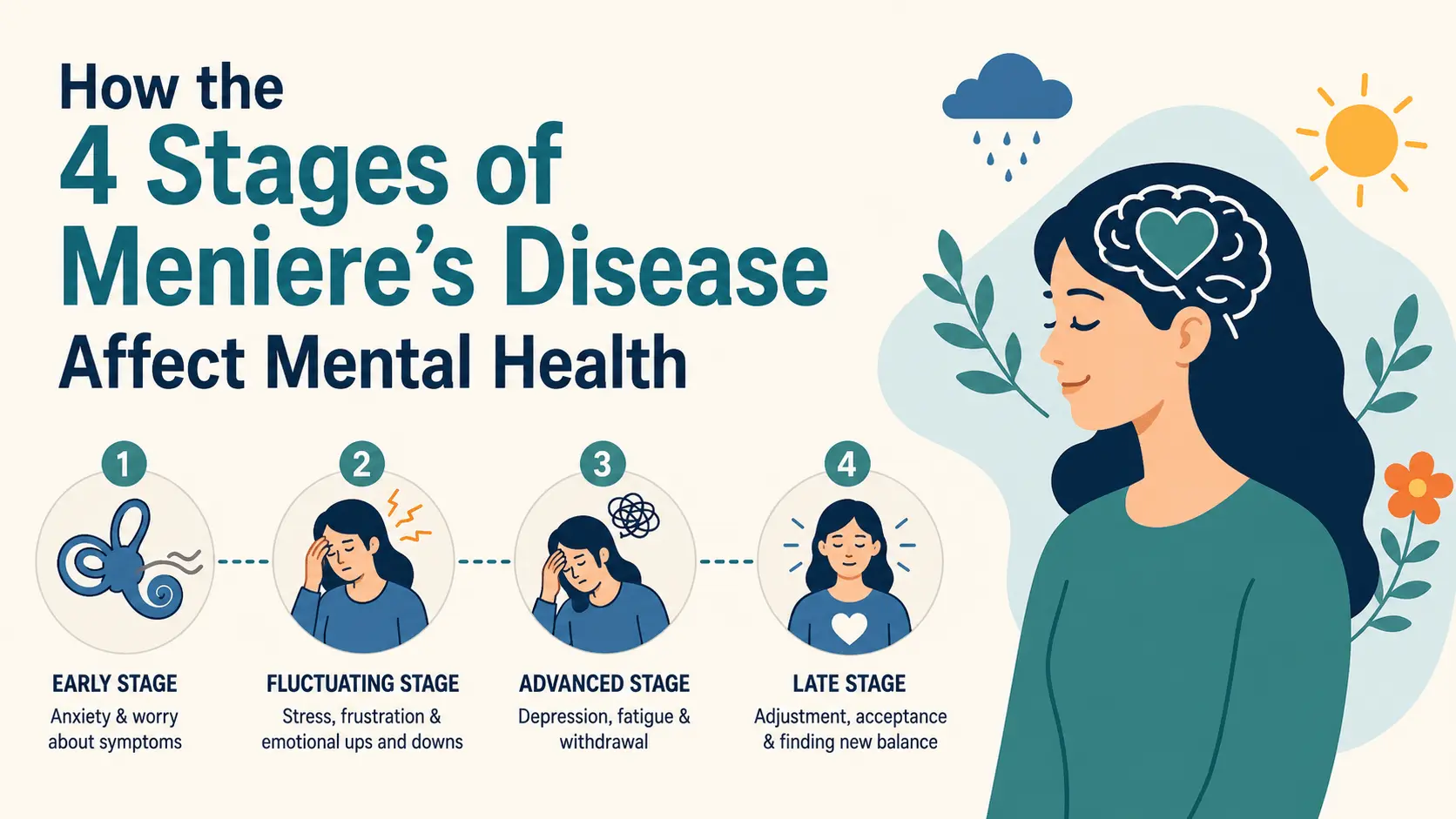
Meniere's disease is a chronic inner ear disorder. It affects balance and hearing. It does not stay the same over time. It moves through four stages. And each one brings new physical and emotional challenges. From the very first unexplained vertigo attack to the long road of living with permanent hearing loss. This condition touches every part of a life.
And mental health is one of the least talked-about sides of it.
People spend years dealing with anxiety, depression, and emotional exhaustion on top of their physical symptoms. Without ever being told that these feelings are a recognised part of the condition. That is not okay. Because the emotional weight of Meniere's disease is real. It is significant and it deserves the same attention as anything happening in the inner ear.
This article walks through how each stage affects emotional well-being.
Takeaways About Meniere's Disease
| Stage | Mental Health Challenges |
|---|---|
| 1 | Anxiety, fear of vertigo attacks, diagnosis stress |
| 2 | Chronic stress, social withdrawal, emotional fatigue |
| 3 | Depression, identity loss, reduced quality of life |
| 4 | Loneliness, adaptation fatigue, lingering fear |
What Is Meniere's Disease?
It is an inner ear disorder. It affects both balance and hearing. It typically develops in adults between the ages of 40 and 60.
Its common symptoms are:
- Sudden and severe vertigo attacks
- Tinnitus, a persistent ringing or buzzing in the ear
- Fluctuating hearing loss
- A feeling of fullness or pressure in the ear
What makes Meniere's particularly hard to live is its unpredictability. The attacks can happen without warning. And last between 20 minutes and several hours and leave a person exhausted afterwards. That unpredictability is one of the main reasons mental health is deeply affected.
Understanding the Four Stages
Meniere's disease does not follow the same path for everyone. But it generally moves through four stages. Each one brings different physical symptoms and emotional challenges.
| Stage | Physical Changes | Emotional Impact |
| 1. | Episodic vertigo, mild hearing changes | Anxiety, fear, diagnostic stress |
| 2. | More frequent attacks, tinnitus worsens | Emotional exhaustion, social withdrawal |
| 3. | Significant hearing loss, balance issues | Depression, loss of independence |
| 4. | Vertigo may reduce, hearing damage persists | Burnout, loneliness, and adjustment struggles |
Stage 1 Early Stage: Anxiety and the Fear of What Comes Next
Physical Symptoms
In the early stage, symptoms come and go. Vertigo attacks are not constant. Hearing changes are temporary rather than permanent. Tinnitus may show up and disappear. Many people at this stage have not even been diagnosed yet and that uncertainty adds a whole new layer of stress.
Mental Health Effects
Anxiety is the dominant experience in this stage. When you do not know when the next attack will hit, your nervous system stays alert.
Common emotional responses include:
- Constant worry about having a vertigo attack in public
- Fear of falling or losing control
- Health anxiety and imagining the worst
- Confusion and stress around getting a diagnosis
A 2016 study in Otology and Neurotology found that Meniere's patients scored much higher on anxiety tests than healthy people. Even in the early stages of the condition.
Early Help Matters
Getting a clear diagnosis early or learning what the condition actually means. Talking to a mental health professional can reduce a lot of distress. Very often, not knowing is worse than reality.
Stage 2 Intermediate Stage: Chronic Stress and Growing Isolation
How Symptoms Progress
In Stage 2, attacks happen more often. Hearing loss starts to settle at a lower level. Tinnitus becomes almost constant. The condition starts to shape daily decisions in a significant way.
Mental Health Challenges
- Persistent anxiety and hypervigilance always scanning for warning.
- Avoiding social events because of hearing difficulties
- Stress at work from poor concentration and lower productivity
- Emotional fatigue from managing symptoms day in and out.
Impact on Relationships
Hearing difficulties make conversation harder. Cancelling plans becomes routine. Partners and family members may not fully understand why. This gap in understanding can quietly erode relationships. And also deepen feelings of isolation.
Stage 3 Late Stage: Depression, Grief, and Loss of Identity
Changes in This Stage
By Stage 3, hearing loss in the affected ear may be permanent. Balance problems are no longer just occasional they are ongoing. The condition has been part of life for a long time now, and it shows.
Mental Health Effects
Depression becomes much more common at this stage. Research published in the Journal of Vestibular Research found that depression rates among people with chronic vestibular disorders including Meniere's disease are two to three times higher than in the general population.
Common feelings include:
- Persistent sadness and low energy
- Grief over the hearing that has been lost
- Loss of confidence in social and work settings
- Pulling away from activities that once brought joy
- A changed sense of self, who am I now?
Psychological Impact of Long-Term Disability
When a condition changes what you can do, it also changes how you see yourself. That link between physical ability and personal identity is one of the most painful and least talked-about parts of late-stage Meniere's disease.
Stage 4 Burnout Stage: Emotional Exhaustion and Long-Term Adjustment
What Happens in this Stage
In this stage, the intense vertigo attacks may slow down or stop. But hearing loss is usually severe and permanent. Balance may still be affected. The body and mind have been through years of chronic illness.
Mental Health Challenges
- Deep loneliness after years of pulling back from social life
- Ongoing fear of vertigo even when attacks have stopped
- Exhaustion from constantly adapting to new limitations
- Grief over a life that looks very different from planned
- Worry about what happens to hearing next
Developing Long-Term Coping Strategies
Stage 4 is also where many people begin to find a new normal. That process is not easy but it is real. The therapy, community, and rehabilitation all play a role in it.
What Research Says About Mental Health in People With Meniere's Disease
- Up to 40% of people living with Meniere’s experience clinical anxiety.
- And people with Meniere’s are, like 2 to 3 times more likely to deal with depression than the general public.
- Overall, individuals with this condition tend to score notably lower on quality of life measures than healthy people, it’s kind of across the board.
- Also, withdrawing from social activities is incredibly common, especially as the illness moves into the middle and later stages.
- Poor sleep is a massive enemy in every single stage. Unfortunately, when you can not sleep. It creates a vicious cycle that makes anxiety and depression feel worse.
Why Vertigo, Tinnitus, and Hearing Loss Increase Mental Health Risk
Vertigo
A sudden vertigo attack is physically terrifying. Even after attacks reduce in frequency, the fear of one happening stays. This anticipatory anxiety can be disabling as the attacks.
Tinnitus
That never-ending ringing, or a buzzing sort of sound in the ear, throws off sleep, focus, and even your peace of mind. Researches have put tinnitus straight with higher levels of anxiety, and depression too. It seems when there is no quiet at all, the nervous strain is really difficult to turn off again.
Hearing Loss
Losing hearing can really mess with how you communicate and socialize. And even how you see yourself. The emotional consequences of gradual hearing loss are real. And people often underestimate them. Especially if they haven’t been through it firsthand. It’s like, day to day things shift. And you don’t always notice how much.
Signs That Mental Health Support May Be Needed
Anxiety Signs
- Worry that feels impossible to control
- Avoiding places or situations due to fear of an attack
- Physical symptoms of stress
Depression Signs
- Low mood lasting more than 2 weeks
- Loss of interest in activities
- Fatigue, hopelessness, or difficulty making decisions
When to Speak With a Professional
If any of the things have been around for more than two weeks, it is worth speaking with a doctor or a mental health professional. This is not really, a weakness thing. It’s more like normal reactions to a hard condition, or some difficult situation, nothing more, nothing less.
Managing Mental Health Through Every Stage
| Support Option | How It Helps |
| Cognitive Behavioral Therapy (CBT) |
|
| Mindfulness and Breathing Exercises |
|
| Hearing Rehabilitation |
|
| Peer Support Groups |
|
| Building a Healthcare Team | Coordinated care across:
|
| Vestibular Rehabilitation | Helps brain adapt to balance changes and reduces fear |
Conclusion
Each of the four stages of Meniere's disease brings its own emotional weight. Anxiety comes early. Chronic stress and isolation build through the middle stages. Depression and identity loss can follow later. And the burnout stage asks a person to find a new path.
Is you or someone you care about living with Meniere's disease? Talk to the doctor about it. You do not have to manage this alone.
Frequently Asked Questions
Can Meniere's disease cause anxiety?
Yes, because attacks come without warning. When you don't know when the next attack will be, the worry becomes usual.
Does this disease increase the risk of depression?
Yes, people with this disease can experience depression. When symptoms start affecting your routine it makes emotions unstable.
Which stage is emotionally the most difficult?
It is different for everyone. Some people find Stage 2 the hardest because symptoms are frequent. Others struggle most in Stage 3.
Can treating anxiety improve its symptoms?
Yes, Therapy, better sleep, breathing exercises, and simple stress management techniques helped many people feel in control.
How can family members help?
Yeah, family help really is important, like it matters more than people think. When you are patient, when you listen closely, understand the feelings they have, and give them time, it builds something steady. And on those rough days, when someone is there with you, everything feels less heavy, even if nothing changes fast.
Are mental health symptoms normal with this condition?
Yes, they are normal. They are a human response to a difficult situation.

Comments