
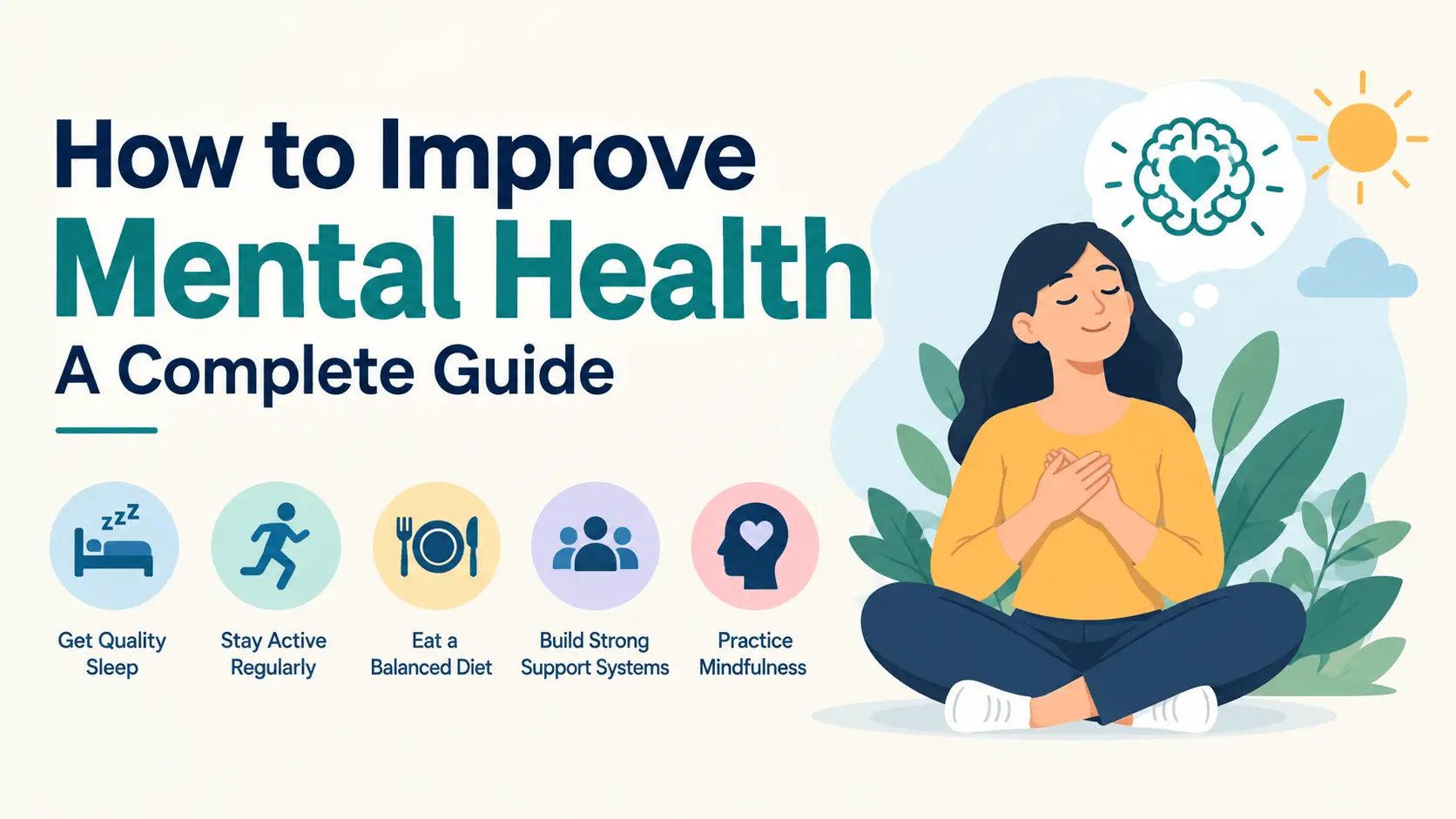
Mental health touches every part of your life. It shapes how you think, how you feel, and how you get through your day. This guide breaks down mental health in simple words. You will learn what it is, what changes it, how to care for it every day, and when to ask for professional help. For a broader look at common conditions, see our complete mental health issues guide.
Core Understanding & Psychoeducation
-
What is Mental Health & How Does It Impact Everyday Life?
Mental health is more than "not being sick." It has three parts:
- Emotional well-being: how you feel inside, like happy, sad, calm, or stressed.
- Psychological well-being: how you think, solve problems, and see yourself.
- Social well-being: how you connect with other people, like friends, family, and coworkers.
When these three parts are balanced, life feels easier to manage. When they are out of balance, even small tasks can feel hard.
Mental health affects your everyday life in real ways:
- Work productivity: When your mind feels foggy or heavy, it is harder to focus, finish tasks, or think clearly.
- Decision-making: Stress and low mood can make small choices feel huge and confusing.
- Daily energy: Poor mental health often drains your energy, even after a full night's sleep.
Think of mental health like the engine of a car. When it runs well, everything else moves smoothly. When it struggles, everything else slows down too.
-
Can My Mental Health Change?
Yes. Mental health is not fixed. It moves, just like your physical health can get better or worse over time. Experts describe this movement using a continuum model. Picture it as a sliding scale with three zones:
- Thriving: You feel steady, motivated, and able to handle life's ups and downs.
- Surviving: You are managing, but things feel harder than usual. You might feel tired, tense, or a little off.
- Struggling: Daily life feels heavy. Simple tasks feel overwhelming, and your mood or energy stays low for a while.
You can move between these zones many times in your life — even in the same month. This is normal. The goal is not to stay "perfect" forever. The goal is to notice where you are and take small steps back toward thriving. Not sure which zone you're in? Our guide to understanding the early signs of mental health issues can help you spot the signals sooner.
-
What Can Affect My Mental Health?
Many things shape your mental health. They usually fall into two groups.
Biological factors:
- Genetics: Mental health patterns can run in families, just like height or eye color.
- Gut-brain axis: Your gut and brain are connected by nerves and chemicals. When your gut health suffers, your mood can suffer too.
- Neurochemistry: Brain chemicals called neurotransmitters (like serotonin and dopamine) help control mood, sleep, and motivation. When these chemicals are out of balance, it can affect how you feel.
Environmental and situational stressors:
- Trauma: Difficult or frightening past experiences can leave a lasting mark on mental health.
- Work-life imbalance: Too much work and not enough rest or personal time can slowly wear you down.
- Financial strain: Money worries are one of the most common causes of stress and anxiety.
Most of the time, mental health is shaped by a mix of both biology and life circumstances — not just one or the other. When these factors combine and persist, they can sometimes develop into a diagnosable condition. Learn more in our guide on what is a psychiatric disorder.
Actionable Lifestyle Medicine & Daily Habits
-
How to Take Care of Your Mental Health: 12 Core Habits
Small daily habits add up. Below are twelve evidence-based habits, grouped into three pillars.
Pillar A: Physiological Care (Caring for Your Body)
- Get enough sleep. Sleep hygiene — good habits like a steady bedtime and a dark, quiet room — helps your brain reset and supports your circadian rhythm, your body's internal clock.
- Eat a nutrient-dense diet. Foods rich in vitamins and minerals fuel your brain and support the gut-brain axis.
- Stay hydrated. Even mild dehydration can affect focus and mood.
- Avoid substance overuse. Too much alcohol or caffeine can disrupt sleep and increase anxiety over time.
Pillar B: Psychological Grounding (Caring for Your Mind)
- Value yourself. Building self-worth means treating yourself with the same kindness you'd give a friend.
- Practice mindful meditation. Mindfulness means paying attention to the present moment without judging it.
- Quiet your mind. Taking short breaks from noise and screens gives your brain room to rest.
- Practice daily gratitude. Naming a few good things each day can shift your focus toward the positive.
- Try cognitive reframing. This means catching a negative thought and looking at it from a more balanced angle. For example, turning "I always fail" into "I didn't succeed this time, but I can try again." This skill is a core part of cognitive behavioral therapy, one of the most researched treatments for anxiety.
- Build metacognition. This simply means thinking about your own thinking. When you notice how you think, not just what you think, it becomes easier to catch unhelpful patterns early.
Pillar C: Behavioral & Emotional Agility (Caring for Your Actions)
- Set realistic goals. Small, doable goals build confidence. Big, unrealistic goals often lead to burnout.
- Learn new coping mechanisms and "do something different." If old patterns keep leading to stress, trying a new routine — a new walk, a new hobby, a new schedule — can help break the loop. This is sometimes called behavioral activation, a way of using action to improve mood.
-
How Does Exercise Improve Mental Health?
Exercise is one of the most powerful tools for mental health, and the reason is biological.
The biological cascade:
- Endorphins: Exercise releases endorphins, natural chemicals that boost mood and reduce pain.
- Cortisol reduction: Physical activity helps lower cortisol, the body's main stress hormone.
- Neurotransmitter regulation: Exercise helps balance serotonin and dopamine, the chemicals linked to happiness and motivation.
Practical movement for real life:
You do not need to run marathons to feel the benefits. Choose what fits your body and schedule:
- Aerobic activity like biking or swimming
- Walking, even 10–15 minutes a day
- Yoga, which combines movement with mindful breathing
The best exercise is the one you will actually keep doing. Movement is especially helpful for managing anxiety and stress as they build up day to day.
-
Social Architecture & Boundaries
Who you spend time with, and how you protect your time, plays a big role in mental health.
- Surround yourself with positive, secure people. Relationships that feel safe and supportive help lower stress and build resilience.
- Give and receive support unapologetically. Healthy relationships involve both giving help and asking for it. You do not need to earn support — it should flow both ways.
- Set boundaries and learn to say "no." Boundaries protect your time and energy. Saying no to things that drain you helps prevent burnout, which is exhaustion caused by long-term stress.
Clinical Intervention & Navigation
-
What Should I Do If I Have a Mental Health Issue?
If something feels off, start with a simple self-check.
- Track your symptoms. Write down what you're feeling, how often, and what seems to trigger it. This is a basic form of self-assessment screening.
- Practice emotional granularity. Instead of just saying "I feel bad," try to name the feeling more precisely — are you anxious, discouraged, exhausted, or lonely? The more exact you can be, the easier it is to figure out what will help.
- Look for patterns. Are your symptoms tied to certain situations, or do they show up no matter what?
- Notice how long it's been going on. A bad day is different from a bad month.
This tracking is not a diagnosis. It is a tool to help you and a professional understand your situation better, if you decide to seek help. If you'd like a structured starting point, try our GAD-7 anxiety assessment or general anxiety test. It also helps to know the non-observable warning signs that don't always show on the outside, and why consistent mental health screening matters over time.
-
When Should I Seek Professional Help?
It can be hard to know the difference between everyday stress and something that needs professional attention. A simple guideline used by many clinicians:
If symptoms last two weeks or longer and start to get in the way of your work, relationships, or daily routine, it's time to consider professional support.
Some clear signs it's time to reach out:
- You've lost interest in things you used to enjoy.
- You're struggling to complete normal daily tasks.
- Your sleep or appetite has changed a lot.
- Friends or family have noticed a change in you.
Seeking help is not a sign of weakness. It's the same as seeing a doctor for a physical illness that isn't improving on its own. If your symptoms feel intense and sudden, it also helps to understand the difference between an anxiety attack and a panic attack. For a deeper dive into specific conditions, see our complete guide to understanding anxiety and complete guide to depression.
-
How Can I Find Help?
Finding the right support does not have to be complicated. Here are the usual first steps:
- Start with your Primary Care Provider (PCP). Your regular doctor can check for physical causes and refer you to a mental health specialist.
- Use directory tools. Many trusted websites let you search for therapists by location, specialty, and insurance.
- Try therapeutic matching services. These tools ask about your needs and match you with a therapist who fits, saving you time.
Getting the right kind of help — whether that's psychotherapy, a psychiatric evaluation, or both — is often the fastest path toward feeling better. These approaches are part of evidence-based practice, meaning they are supported by research. Explore our therapies and treatments hub to compare options, including outpatient therapy, an intensive outpatient program, or residential mental health treatment for higher levels of care. You can also contact us directly if you're not sure where to start.
Conclusion
Mental health is not a fixed state — it moves along a continuum, shaped by biology, habits, relationships, and life circumstances. The good news is that you have real influence over it.
Small daily habits like sleep hygiene, movement, gratitude, and cognitive reframing build a strong foundation. Healthy relationships and clear boundaries protect that foundation. And when symptoms last longer than two weeks or start affecting your daily life, professional support — through your PCP, a therapist, or a psychiatric evaluation — is the next right step, not a last resort.
You do not have to figure this out alone, and you do not have to wait until things feel unbearable to ask for help. Start with one small habit today, keep an eye on how you're feeling, and reach out for support the moment you need it.
Crisis Resources
If you or someone you know is in crisis, crisis intervention — immediate support to keep someone safe during a mental health emergency — is available right now. These are trusted, national resources you can reach at any hour:
- 988 Suicide & Crisis Lifeline: Call or text 988 anytime, day or night. Visit 988lifeline.org →
- Crisis Text Line: Text HOME to 741741 to reach a trained crisis counselor. Visit crisistextline.org →
- SAMHSA National Helpline: Free, confidential, 24/7 treatment referral and information service. Call 1-800-662-4357. Visit samhsa.gov →
- Campus and local resources: Many schools and communities have their own crisis lines and counseling centers. Check with your school, workplace, or local health department for specific options near you.
If you are in immediate danger, please call 911 or go to your nearest emergency room.
This content is for educational purposes and is not a substitute for professional medical or mental health advice. If you are experiencing a mental health crisis, please use the resources above or contact a licensed professional.
Frequently Asked Questions
What are the quickest ways to calm down during an anxiety spike?
The fastest ways to calm an anxiety spike are box breathing, the 5-4-3-2-1 grounding method, and somatic discharge — simple physical resets that calm your body and mind within minutes.
Box breathing — Breathe in for 4 seconds, hold for 4 seconds, breathe out for 4 seconds, hold for 4 seconds. Repeat.
The 5-4-3-2-1 grounding method — Name 5 things you can see, 4 you can touch, 3 you can hear, 2 you can smell, and 1 you can taste.
Somatic discharge — Simple physical actions, like splashing cold water on your face, shaking out your hands, or stretching, help release built-up tension and calm your nervous system.
For more techniques, see our guides on how to control anxiety instantly and the 3-3-3 rule for anxiety.
How do I know if my mental health is actually declining?
Common signs your mental health is declining include pulling away from people, losing interest in things you enjoy, changes in sleep, and feeling irritable more often than usual.
Social withdrawal — Pulling away from friends and family.
Anhedonia — Losing interest or pleasure in things you used to enjoy.
Sleep disruptions — Sleeping much more or much less than usual.
Chronic irritability — Feeling on edge or easily frustrated most of the time.
If you notice several of these signs together, and they last more than a couple of weeks, it may be time to check in with a professional. Some warning signs aren't visible to others at all — read more about these non-observable warning signs of declining mental health.
Can lifestyle changes alone cure depression or anxiety?
No. Lifestyle changes can meaningfully help mild-to-moderate symptoms and prevention, but clinical depression or anxiety usually needs professional treatment alongside healthy habits, not instead of it.
Lifestyle medicine — things like sleep, exercise, and nutrition — is a strong foundation. For mild-to-moderate symptoms, or for preventing problems before they start, these changes can make a real difference.
However, for clinical conditions, lifestyle changes alone are usually not enough. Comprehensive treatment, such as psychotherapy or psychiatric care, often works alongside healthy habits for the best results. Think of lifestyle changes as the foundation of a house — necessary, but not the whole structure. Explore our depression and psychiatric disorders sections, or learn how cognitive behavioral therapy for anxiety works alongside lifestyle changes.
What are important national resources for immediate crisis support?
If you're in crisis, call or text 988 (Suicide & Crisis Lifeline), text HOME to 741741 (Crisis Text Line), or call 911 if you're in immediate danger. Full details and links are in the Crisis Resources section below.
Comments